
SPECIFICATIONS
GENERAL
Type: Amateur VHF transceiver
Frequency range: Europe and Japanese domestic market
TX: 144-146 MHz
RX: 144-146 MHz
USA
TX: 143.9-149 MHz
RX: 143.9-149 MHz
Tuning steps: 100 Hz, 12.5 / 25 KHz (Europe)
100 Hz, 5 / 10 KHz (USA)
Frequency stability: Within ±500 Hz during the first hour after 1 minute warmup
Within 50 Hz any 30 minutes thereafter @ 25° (77°F)
Mode: FM / SSB / CW
Channels / memory management: 5 regular (Memory 5 can also store “odd split”)
RAM storage (Backup power option, male 3-pin jack)
Repeater shift / offset: ±600 KHz
Power supply: 13.8 VDC ±15% (Male 2-pin jack)
Current drain / power consumption: RX: Max 400 mA (Squelched)
TX: 1.3-2.9 A
Antenna impedance / connector: 50 ohm / SO-239
Dimensions (WHD): 17068234 mm (6.692.689.21″)
Weight: 2.5 Kg (5.51 lb)
Other features: 1750 Hz repeater ton (Europe). NB. RIT.
RECEIVER SECTION
Receiver system: Single conversion superheterodyne (SSB/CW)
IF: 10.695 MHz
Double conversion superheterodyne (FM)
1st IF: 10.695 MHz
2nd IF: 455 KHz
Sensitivity: FM: 0.25 uV (12 dB SINAD)
SSB/CW: 0.25 uV (10 dB S/N)
Squelch sensitivity: 0.2 uV (Threshold)
Selectivity: FM:
12 KHz (-6 dB)
25 KHz (-60 dB)
SSB/CW:
2.2 KHz (-6 dB)
4.8 KHz (-60 dB)
Image rejection:
AF output power / speaker: 2 W at 10% distortion / 8 ohm
External speaker connector: TS “Minijack” (3.5 mm)
TRANSMITTER SECTION
RF output power:
High Low
FM: 10 W 1 W
SSB (PEP): 10 W 1 W
CW: 10 W 1 W
Modulation system: FM: Variable reactance
SSB: Balanced
Max FM deviation (Factory set): ±5 KHz
Spurious emissions: High: Better than -60 dB
Low: Better than -46 dB
Microphone impedance / connector: 500 ohm / 6-pin (Male locking ring jack)
After running several 145Alive events here in England, it was decided by the event organisers to try out SSB and not just FM.
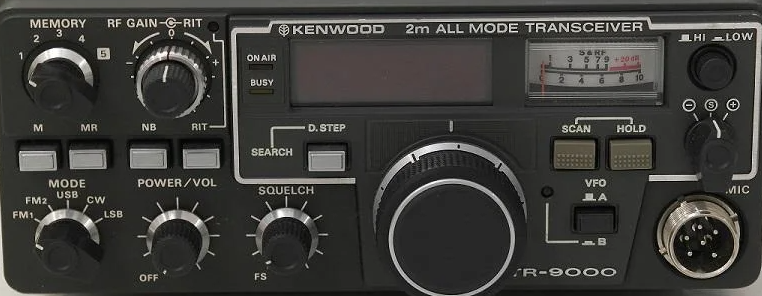
I decided to take the plunge and convert to an older transceiver that had SSB, it was not an easy choice however. I had often considered the cost implications of obtaining a new HF/VHF/UHF rig or go for a cheaper mono band solution. I was looking around at the Chippenham Radio Rally in Wiltshire in 2025 and set my eyes upon the Kenwood / Trio TR-9000
£100 pounds later i walked away with what i was hoping to be a good transceiver. I was not disappointed. The feature set was exactly what i expected for a transceiver of this vintage. No CTCSS (it is trivial to add one), low power (10Watts) but i was fortunate to have got a good unit.
In use, the transceiver does require a little warm up time that is to be expected. Switch it on half and hour before use and the oscillator drift becomes quite stable. I also realised that the default 10Watts out from the radio was not going to cut the mustard. I promptly took a chance on a small mono-band Amplifier from Microwave Modules (30 watt out) that i also rescued from a radio rally. I was hoping that the unit was fine with no blown finals. I took the chance and i was pleasantly surprised to have some really good contacts with it. The first thing that struck me was the audio quality. Smooth, deep clear audio booming through when properly tuned. I must admit that it did sound more like FM in use!
Fast forward to the present day, the radio is still working but does require a complete change of Electrolytic Capacitors as over time, they do dry out and present a change in Capacitance (and ESR) that plays havoc with the operation of the unit. I found one of the Caps weeping electrolyte from it’s base. I promptly took measures to avoid any further damage to what is a legendary vintage radio.
If you are in the market for an older vintage SSB transceiver for 144MHz, i can vouch for the TR-9000, IC-251 and the Kenwood TS-700s. However, before you purchase one, take it for a test drive and check the power output and modulation on air. These are not cheap to repair as parts are becoming incredibly rare, not to mention expensive.
Why i chose to go this route is two fold. I already had a FT-891 in the car. Was i prepared at the time to purchase something like the Icom IC-7100 that has everything the FT-891 has but with VHF / UHF? Was it going to be worth the price? For me, no it was not. Not at the time certainly. Maybe in due course i may decide tio take the plunge, at least i would have a backup HF rig for my primary if anything ever happens to it. The IC-7100 does NOT have the deep, warm audio dynamic range that vintage radios have. That’s just the way it is for newer SDR based radios. I cannot fault the feature set of the 7100 though and i did enjoy using one on a couple of occasions when my FT-7900 packed up (Thanks Reece M7DVX)
The other reason i chose to go old school was that i see myself as an experimenter and not just some one who operates a transceiver. This i believe strengthens the learning curve and the understanding of what stages of the transceiver are responsible for doing what. Once you understand this, i believe that this gives you a unique position to repair your own equipment and avoid costly repair bills.
I have had soo much enjoyment from operating and repairing older transceivers, i also happen to have a Kenwood TS-700s to repair and align. I’ll make a page for this here and i will try to update all the content here in due course. Please bear with me, i have a lot to do!
Kenwood Trio TR-9000
User and Service Manual


You must be logged in to post a comment.